


PWF - Slovenian export success

In the north-eastern part of Slovenia, the Jeruzalemski bregi, along the border with Croatia, are Ormož and Ljutomer / Štajersko Podravlje. Two towns and two large wineries that produced as much as 15 million liters of wine in the post-war Yugoslavia. And the history of the Puklavec winery begins in 1934 when Martin Puklavec became the director of the wine-growing and winemaking cooperative in Ormož.

Even then, the idea of a large multi-storey cellar was born, which was finally completed in its current form in 1967. In order to obtain this impressive underground space with 5 floors below ground, 25 meters high, and two floors above ground, it was necessary to dig up a hill located in the immediate vicinity of the Drava River, and there used to be a railway at the foot of it, which was used to transport wine.

From top to bottom it looks like this: On the second floor is the old tasting room, on the first are the winery offices. On the ground level is the reception and grape pressing. Below on the -1 and -2 floors are large-capacity concrete storage rooms that are no longer used today. On the -3 level are wooden barrels from 225 to 2000 liters with a total capacity of 70000 liters. On the next -4 floor, around 140,000 bottles of sparkling wines made using the classic method are matured, and on the -5 level, automatic bottle cleaning (ridling) is carried out.

In 2009, Vladimir Puklavec bought the Ljutomer and Ormož wineries, modernized them, and today his business is very successfully continued by his daughter Tatjana Puklavec with selected experts under the name Puklavec Family Wines. The winery today produces about 3.5 million liters of wine, or the equivalent of 4 million bottles. They export about 30% of their total production to 25 countries worldwide, and since last year, Croatia has been the largest importer (Muscat Yellow, Muscat Ottonel, sparkling wines, and Laški Riesling).

They get their grapes from 470 of their own hectares, around 150 recently planted ones that are not yet in fruit, and 130 hectares from subcontractors in their area. The most important varieties are Sauvignon Blanc, Pinot Gris, Pinot Blanc, Chardonnay, Rhine Riesling, Traminer, Šipon, Yellow Muscat, and Muscat Ottonel. The largest number of hectares is under Sauvignon Blanc; the second-largest is Laški Riesling. The winery's intention is for Šipon to be their brand variety in Slovenia and the wider region.

In total, they have 70 labels on the market. In recent years, they have been paying increasing attention to sparkling wines (penini), and in addition to the three Brut labels, they have an increasing number of sparkling wines produced using the Charmat method, which are especially overseen by enologist Darija Peček.
They have kept around 250,000 bottles in their archives since 1959, selling 5-10 thousand bottles each year, which they renew with the same amount from the vintage.

In addition to a large number of medals at world competitions, Puklavec Family Wines also has two as the best Slovenian wine producers in 2024 in Vienna at the AWC and at Mundus Wine in Meiningen in 2025. The premium line 7N, which we tasted 5 times, is obtained from grapes from the seven best selected locations, and is intended for specialized stores, restaurants and wine shops.

At the promotion at HKD Napredak, the chief oenologist (ex. Badel, Daruvar, Orahovica) Luka Radiček spoke about the wines. That good decision to have him represent the winery allowed us to find out a lot of information about the winery itself and of course first-hand important things about the wines themselves. We tasted eight wines in this order: 1. Brut7N sparkling wine 2019 12.5% alcohol 2. Šipon 7N 2024 12.5% 3. Pinot gris 7N 13% 4. Sauvignon 7N 2022 13% 5. White cuvee 34 2021 14% 6. Trois Femmes 2021 12% 7. White pinot 1983 11% 8. Traminac 7N 2023 9.5%

Here I will mention the characteristics of five wines.

1. Brut 7N Penina 2019 is made from 50% Pinot Noir, 40% Chardonnay and 3% Žipon. It was disgorged in January 2025. Clear wine, the smell is ripe, you can feel the characteristic smell of apple, ripe peach. Solid body, well-balanced acidity. Nice freshness, yeast is not dominant, pronounced minerality... a gastronomic wine with oysters, among other things. Sparkling wines account for over 20% of the total volume in sales. The price is very good compared to the value of 17 euros.

The second wine was Šipon 7N 2024 with 12.5% alcohol, for which grapes from the Grand Cru location Mali Kog are selected. Šipon is one of the most important varieties in Slovenia. In Hungary it is Furmint and in Croatia it is Pušipel and Moslavac. The wine is clear, golden yellow in color; the aroma is yellow apple and yellow flowers (primrose). In the mouth, it is drinkable with the taste of lemon, peach, and honey. The oenologist informed us that only single fermentation is used, it ferments in stainless steel barrels then in wooden barrels of 500 and 1000 liters with fine yeasts for another 10 months, returns to stainless steel and is bottled and aged for at least another 4 months before being released on the market. The conclusion is that this wine will have its peak in a year. Lugarić chose monkfish cooked in šipon and sweet potato puree as an accompanying dish and generally white fish. Šipon received 95 points and a flat medal at Decanter in 2015.
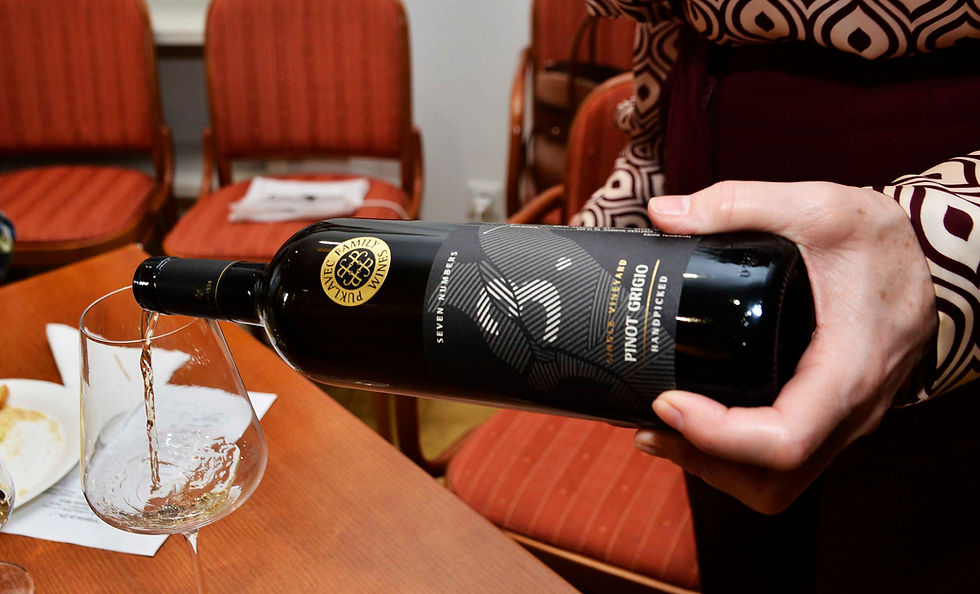
Pinot Gris 7N 2022 13% alcohol is a wine with slightly reddish tones that turn into the color of old gold or copper. Although 4 years old, it is still lively, with an intense aroma of ripe apple, pear, peach and apricot. It is distinctly mineral, salty with a slight influence of wood and a slightly bitter aroma. The wine has a slightly lower acidity but is nice-bodied and the variety is suitable for making bortitis wine due to the thin skin of the berry. Gastronomic recommendations are extensive: natural veal steak with puree, breaded okra, baked eggplant with cheese, breaded oyster mushrooms.

Sauvignon 7N 2022 13% alcohol is a dry wine and the grapes come from the Klump location and, according to Radiček, they are harvested three times. When it is still green, then at full maturity and finally in the overripe phase (about 10%). This variety has a significant place in the winery, and the wines have been confirmed at international competitions. Thus, the 2021 vintage was the best wine at Mundus vini 2023. The wine we tasted has a beautiful golden yellow color, an intense aroma reminiscent of passion fruit, red grapefruit, and elderberry. Fresh, mineral, full-bodied in the mouth. Here we received a recommendation from Darko, a former restaurateur, to pair the wine with risotto of Adriatic shrimp and saffron, grilled scampi.

The White cuvee 34 2021 wine with 14% alcohol, dry, is dedicated to Martin Puklavac, who became the director of Ormož in 1934, hence the number 34 as a kind of homage. Although all the wines were of a high level of quality, this blend of six varieties - sauvignon blanc, pinot gris, chardonnay, pinot white and Laški Riesling and Riesling (which were harvested at a later stage) - remained in my deepest memory. With an intense but elegant aroma, the wine is yellow in color with green hues, crystal clear, full-bodied in the mouth, fruity, mineral, with significant but well-integrated alcohol, and also wood. For the dish, we were recommended stuffed ravioli with cow's cheese and a selection of forest mushrooms and all the appropriate meats.

This wine is not produced every year, but in the best ones, Radiček told us, like 2021, and it is in the category of ultra-premium wineries. Last year, in Gornja Radgona, the most important Slovenian judging event, he was the Champion of matured wines.
At the end, I will just mention the great gold award at Decanter last year for the 1983 Pinot Blanc. Mrs. Elena expressed an opinion shared by the rest of the workshop. The wines of Puklavec Family Wines are high-quality and recognizable. The great reception among the Croatian wine audience only confirms this.


Comments