


Flavours of Mohacs in Busóudvar Restaurant

You don’t come to Mohács just for the Danube, history and that famous line about how “more is lost at Mohács”. If you want to get to know the city through your plate, it’s hard to find a better place than Busóudvar, a restaurant located next to the eponymous space dedicated to Mohács’ most famous custom – busas. It’s clear from the entrance that this is not a restaurant trying to be anywhere else. Three large sculptures of busas welcome guests in the courtyard, and a few steps away the story of a city where Hungarian, Šokac, Croatian, Serbian, German and Turkish gastronomic heritages intertwine begins. Busóudvar Étterem opened in December 2013 as a family restaurant, with the idea of showcasing Mohács and the taste of its region through food.

It is run by the extremely educated and professional chef István Havasi, recognizable by his Austro-Hungarian mustache, but above all by his home-made food that reflects every inch of the Mohács region. Together with a select and experienced team, he gave us an unusual welcome, in the company of an excellent connoisseur of Mohács gastronomy and culture, Imre Miskolczi. Such a tandem is the best way to delve deeply into the culinary culture and heritage of this Danube city.

And the buses here are much more than just tourist decor. The Mohács Busójárás is one of the city's trademarks, a tradition that was inscribed on the UNESCO list of intangible cultural heritage in 2009. Men in huge fur coats, with wooden masks, rattles and bells, traditionally say goodbye to winter and call for spring. In Busóudvár, this whole story is physically present: the permanent exhibition space preserves dozens of dressed buse figures, old masks and props, and traditional Croatian-Sokac melodies can also be heard in the space. It is no coincidence that the restaurant is located right here. The idea is that after looking at the masks, old customs and the history of the city, we sit down at the table and eat what we have just seen. The restaurant is quite honest in its ambition: it wants to present the “mohácsi ízek”, or the flavours of Mohács and its surroundings. This means that on the same table you can find fish dishes related to the Danube, Hungarian classics, Šokac dishes, dishes of Croatian and Serbian tradition, but also traces of Turkish cuisine.
To start, we started with something that perfectly speaks of the Danube and the local way of thinking about fish, which is haltöpörtyü lilahágával, or carp fish cracklings with purple onion. It sounds a bit strange if you are used to the word cracklings being automatically associated with pork, but that is precisely the charm of this snack. The pieces of carp are fried in such a way that they get that desirable crispy, almost crunchy texture, while the purple onion brings freshness and light sweetness, and the ground paprika gives the whole story a recognizable Hungarian signature. There is no unnecessary embellishment here: fish, fat, onion, paprika and a good sense of proportion. A bite that demands another bite and, of course, a sip of wine.
Then comes the Mohácsi halászlé, Mohács fish soup, one of the dishes for which this region has long been famous. The proximity of the Danube has determined the local diet, so it is not surprising that fish dishes have been a part of everyday life for centuries. At Busóudvar, they emphasize that Mohács fish soup has developed from a simple dish of freshly caught fish and a few basic ingredients into a widely known specialty today.
What is always most important in a good halászlé is balance: the paprika must be present, but must not suffocate the fish; the soup must be strong, but not heavy. Here we experienced it exactly as it should be, as a serious, rustic and delicious dish that you only understand best when you know where it comes from.
We continued the fish course with a whole baked süllő, or perch, served with mashed potatoes. The fish arrived at the table whole, baked, with that fine skin that is the first sign that the fork will penetrate the meat almost without resistance. But the real surprise was the puree.
Not the kind that exists only as a decent accompaniment to fish, but an extremely creamy, silky puree that almost demanded the main role with its fullness. With the tender, clean meat of the perch, we got a very simple but precise combination. Without much philosophizing: good fish, good potatoes and a kitchen that knows when to stop.

And then we turned to another great Mohács gastronomic story: szürkeharcsa pörkölt túrós csuszával, or catfish perkelt with traditional pasta with cottage cheese. If halászlé showed the Danube in the form of a soup, here we get it in a much stronger version. The catfish is meaty, plump and almost meaty in character, and the perkelt wraps it in a thick, peppery sauce. The túrós csusza adds creaminess, the freshness of the cheese and that pleasant rusticity that brings the whole dish back to the home table. It's one of those plates that may not try to look spectacular, but it disappears very quickly. And that's exactly why it's good.

We drank wines from the immediate area with the food, which in a restaurant like this is almost as important as what's on the plate. Busóudvar emphasizes local wineries and the fact that Mohács and the surrounding area belong to the wine The Pécs region, with its long tradition of viticulture. Today, more and more wines are produced here in smaller family wineries, and Eberhardt Pincészet holds a special place among the restaurant's house selections. We had Mohácsi Chardonnay 2025 Eberhardt with lunch, a fresh and drinkable wine that went well with fish, but also Mohácsi Cirfandli Eberhardt, an interesting local variety that is particularly appreciated in this part of the country. Cirfandli is almost a small wine signature of the region, a variety known primarily in this wine region, prone to noble botrytis, and therefore a nice alternative to the more expected international varieties.

And just when you think you're done with the history at the table, the restaurant pulls out another trump card: a special sultan's menu prepared to mark the 500th anniversary of the Battle of Mohács. The year 2026 in Mohács is, of course, special because it marks half a millennium since the battle of August 29, 1526, an event deeply inscribed in Hungarian historical memory. For this anniversary, Busóudvar has prepared a historical offer, available with prior notice and for a minimum of ten people. The idea itself nicely rounds off the restaurant's concept: here, history is not just something that is explained to tourists, but also the inspiration for the menu. And in Mohács, a city where Central European, Balkan and Ottoman pasts meet, such a combination of food and history is particularly natural.
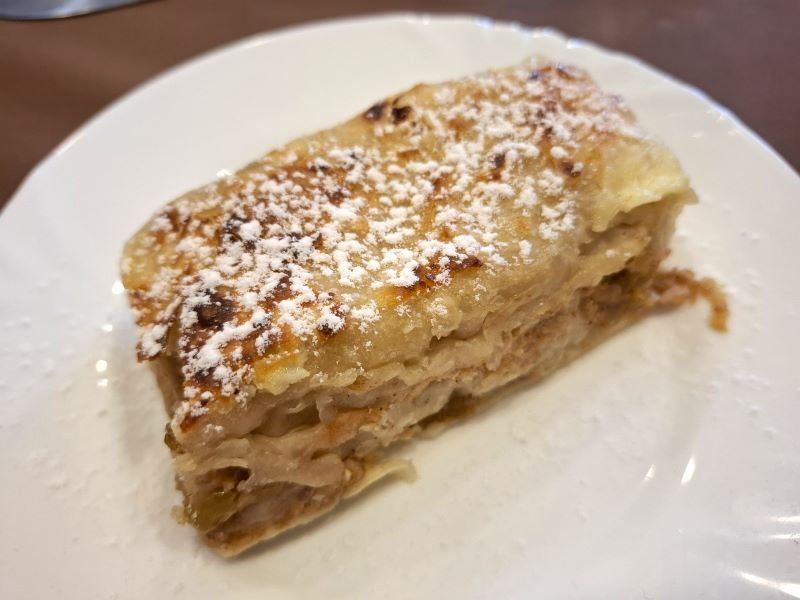
Finally, házi almás-túrós rétes, a homemade apple and cheese roll, arrived. After all, dessert came as a kind of calming down. The apple provides fruity freshness, túró (Hungarian cottage cheese) that characteristic mild milky fullness, and the thin crusts hold everything together in the familiar form of rétes. This is not a dessert that wants to impress with its exoticism; its strength lies in the feeling of being homely. And it is precisely such an ending that fits best into the whole story of Busóudvar, a restaurant that does not build its value on moving away from tradition, but on serving it in a way that is understandable to today's guest. The house itself particularly highlights the homemade apple and cheese strudel among its desserts.
But perhaps the most beautiful sight came only after the meal. In front of the museum, on a live fire, beans were slowly simmering in ceramic pots. The flame crackled, the clay pots darkened from the fire, the contents moved gently under the lid, and the smell of smoke, beans, vegetables and meat spread throughout the courtyard. It is a sight that explains better than any menu what Busóudvar actually wants to be. The beans here are prepared in clay pots, according to the centuries-old tradition of the local Šokács, from beans, smoked meat and vegetables, seasoned more boldly and cooked over a fire. Watching them slowly cook after you have already tried fish soup, carp, perch, catfish, local wines and strudel means actually ending the whole story where it began, by the fire, customs and people. In Mohács, it seems, history is best remembered at the table. And in Busóudvar you can also eat very well.
Busóudvar Étterem és Kávézó
7700 Mohács, Eötvös u. 17-19
Tel: +36 70 3200 116


Comments