


Murter and Latin Sail

Rarely, if anywhere, can you find a place on the islands of the Adriatic where people have lived for centuries (the island of Murter was first mentioned in 1318, but traces of settlement date back to the Illyrian and Roman times) at the same time as farmers in the fields, fishermen and herders, and sailors. You could find all of this in the man who lives here. Thanks to its location, Murter is the closest settlement to the Kornati Islands (locals call it Kurnatski), and the inhabitants have always used this duality of mainland/islands. Of course, the place is on an island, but it is practically a continent in relation to the distant Kornati.

To reach their properties, the people of Murter rowed and sailed for hours when there was a "vitra" to get to their island where they had livestock and even vineyards. It was a hard life, but they were rewarded with meat, fish, and agricultural products. They brought all these fruits from their travels and stored them in the taverns in Murter because they had temporary modest shelters on the islands. Until recently, livestock, primarily sheep, lived in the wasteland of the rocky terrain, but today they are rare exceptions compared to the time not so long ago when there were plenty of them on numerous islands.
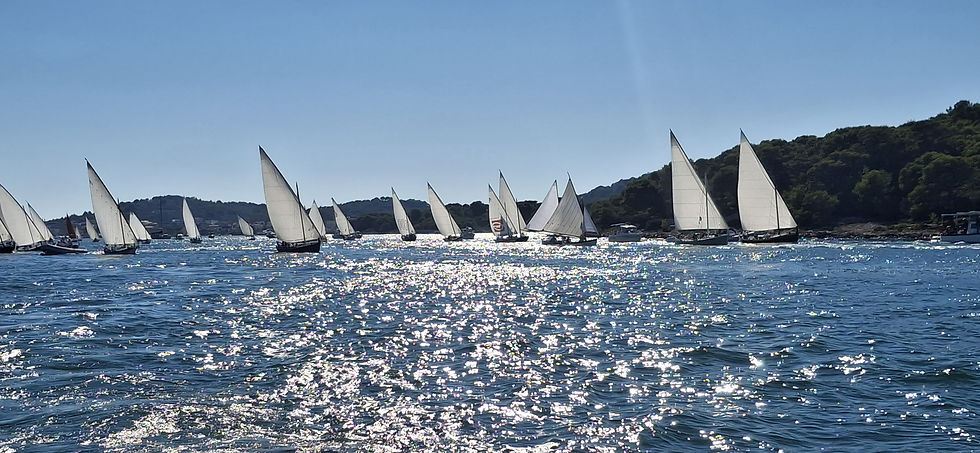
Why am I writing this in the introduction? Precisely so that we can get to the gajets and leuts that had sails in addition to oars. And that was the Latin sail. In honor and memory of their ancestors in 1998, Željko Jerat, Vladimir Skračić, Ferdinand Pleslić - Grob and Josip Juraga Jole initiated the first race, having struggled to find those first seven vessels. Years later, 60 to 80 wooden gajets, leuts and kaićs with a Latin sail (idro) participate in each regatta. The first organizer was Denis Magazin from Betina JK "Žal" and for two full decades the late Željko Jerat and Branko Rameša took care of the race.
This event, which has been going on for 28 years and will celebrate its 30th anniversary next year, is also a sporting event because it is about seeing who will cross the finish line first and a great homage to Murter's ancestors who did not have time to race but had to row/sail painstakingly, often after a whole day, to their island. And there are many of them in the Kornati Islands, almost like days in a year.
That is why this regatta was created both as a memory and as a tourist attraction organized by the descendants, who today mostly live from tourism, of their ancestors...Navigare necesse est, vivere non est necesse (to sail is NECESSARY, to live is not NECESSARY) says this saying attributed to the Greek historian Plutarch. It has been permanently confirmed in the lives of the people of this region throughout the past centuries...
Thus, the 29th Latinsko idro gathered over 60 boats and ships and Raimond RANDI was the first to cross the finish line in the Kvarner boat category with his boat Kade si. Among the GAJETA, Damir ČORKALO in the boat Sirotica was first, Viktor Lapov Padovan in the boat Baba Luce was second, and Vice Jušić with Ilko was third.
In the LEUT category, Mladen MUDRONJA in the boat Mladen was first, Ante FRŽOP in the boat Orlić was second, and Željko BURTINA in the boat Gušte was third.
Among the KAIĆ, Tomanek REINER in the boat Bruka was first to cross the finish line. Ana ŠOIĆ in the boat Marija was second, and Ivan CRLJENKO in the boat Rajna was third.
With this, the organizers once again confirmed that they are excellent in the sports part, but also in the gastronomic part, believe me, because I have a lot of experience in that too. From the brunch for the participants of grilled sardines, to the Sunday lunch with grilled tuna, to the traditional goulash with "pašta" at the final dinner. There was music from the loudspeakers and the singing duo Neno and Valerijo (accordion and guitar), and songs by the Adria a capella group, all of which were accepted by the singing and cheering audience and competitors. In the evening, the winners were announced on the central local square of Rudina.
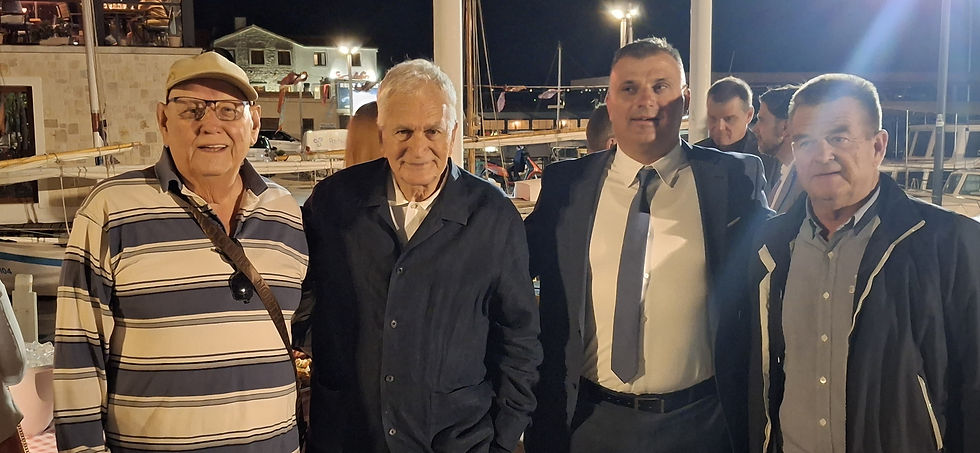
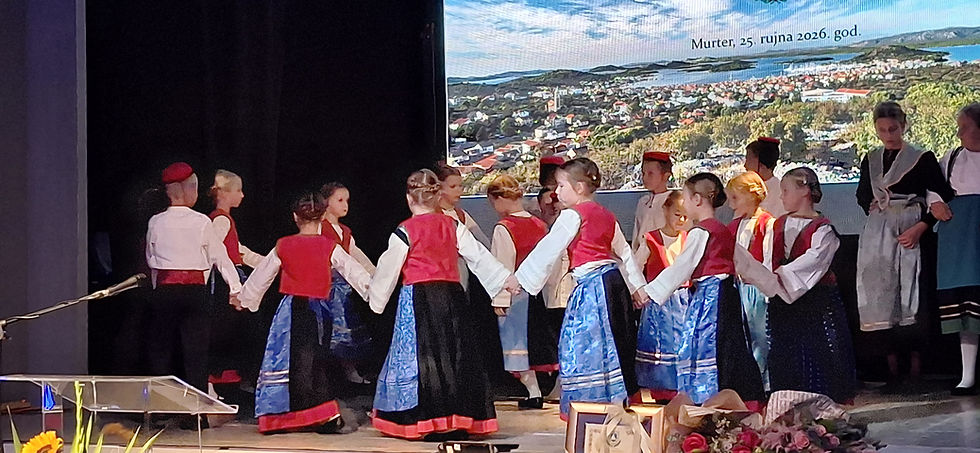
The days leading up to the race itself, which started at 3 pm on Sunday, were filled with significant events. On Friday, a ceremonial session of the Municipal Council was held, attended by the Minister of Tourism Tonči Glavina, the envoy of the President of the Republic of Croatia Tomislav Paškvalin and numerous guests from the Šibenik-Knin County. The awards, four of them, were presented by the President of the Murter Kornati Municipal Council Tina Lovrić and the Mayor Šime Ježina. The annual winners are: Marta Duić, Dominik Kožina and posthumously Milan Papeša. The Lifetime Award was presented to 92-year-old Miljenko Mitro, a teacher, pedagogue, cultural worker and president of the MH branch in Murter, who expressed his gratitude on behalf of the awardees. The program, in which the "Zora" cultural and artistic community from Betina participated with numerous young folklorists and the Adria klapa, was successfully led by Mare Kovačev.
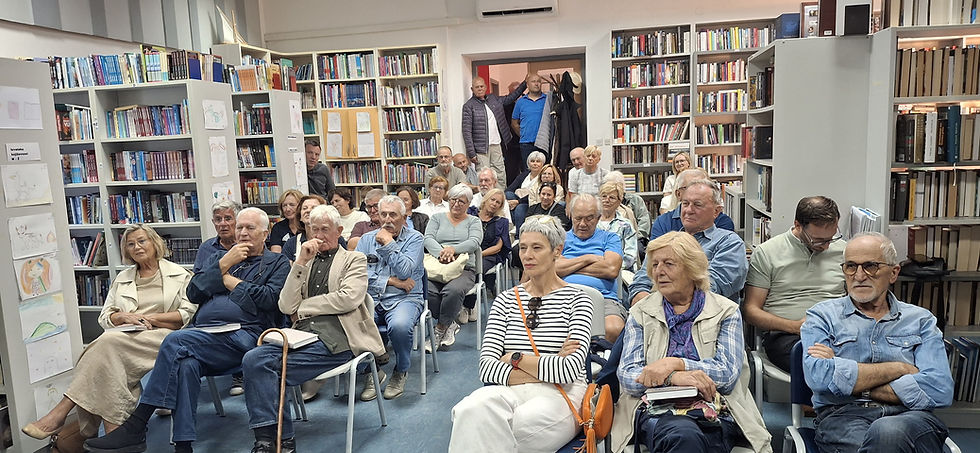
The next day, in a packed local library, it should be noted that Murter has had this institution, the oldest in Dalmatia, since 1866, the Murter Yearbook, issue 19-20, was presented. Edo Juraga gave the opening speech and Prof. Vladimir Skračić gave the floor, who has written several books about the Kornati Islands and has extensively participated in the Yearbook, which is always well-read and quickly sold out. The main topic of discussion was the so-called bilizi (marks) on the ears of sheep to identify their owners. Boris Turčinov also shared his experiences in collecting material about this. Prof. Tomislav Skračić spoke about the poetry of two Murter poets, Jerko Skračić and Mirko Mudronja. The verses were read by Ms. Tanja Skračić. A very pleasant and instructive 50 minutes. At the exit I met Ivica Lovrić, a shepherd from Stiniva, where he lives with his wife Radmila during the year. His large flock of sheep was ravaged by jackals, and he told me on that occasion: "There is no more sheep herding for me, it's over". A sad story that is also told by livestock farmers and farmers on the continent and in Dalmatia, and the cause is a wild boar.
Finally, I believe that the beautiful story of the wooden boats gajeta and leut will last for years to come, certainly through the aforementioned regatta, because new times have come, stronger materials from which boats are made and powerful engines that can reach the first island of Opat at full speed "in half an hour and a half of rowing and sailing". It's not all about speed, fans of leut and gajeta and LATIN IDRO will say! And I agree...
Next year, the 30th anniversary race is expected with probably the largest number of participants. There should certainly be high patronage from the President or Prime Minister. There is no doubt that there will be many sailing and old boat enthusiasts, as there were from Friday 25th to Sunday 27th September this year, on the eve of the Day of the Municipality of St. Michael, the patron saint of Murter and Kornati.


Comments