


A Modern Third-Generation Winery – Ferenac

Historically, the Ferenci/Ferenzi family is mentioned as far back as 1688, when the ancestors of Giulio Ferenac arrived in what is now Istria from the Venetian region. Vine cultivation continued through dozens of generations, and by the late 1980s more serious market-oriented production was initiated by Marčelo (the grandfather) and Giulio (the father) of Marijana Ferenac, who is today increasingly taking care of the winery alongside her father.

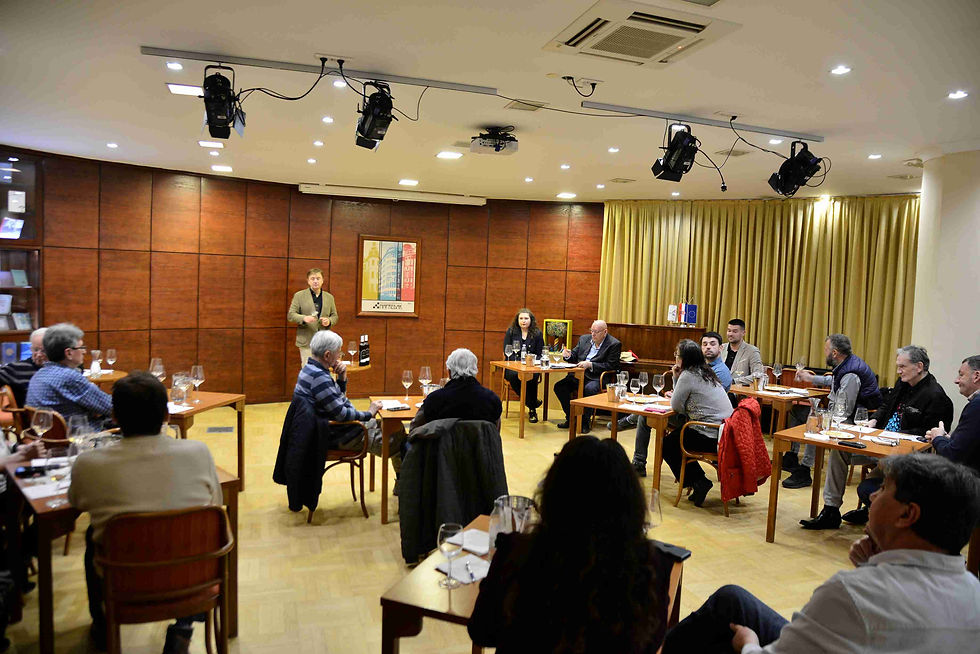
Marijana Ferenac graduated in 2021 from the Faculty of Agriculture in Zagreb, earning a Master’s degree in Horticulture with a specialisation in viticulture and oenology. Behind this rather lengthy title stands a personable and well-educated winemaker who clearly demonstrates, through the wines we had the opportunity to taste at HKD Napredak, both knowledge and a firm vision of how her wines should be shaped. This was confirmed during the workshop “Vrijeme je ZA…” by authorities from the oenological and journalistic fields, Franjo Francem and Željko Suhadolnik, with the assistance of sommelier Darko Lugarić, who led the presentation of eight wines from this winery near Vižinada.
Before describing several of the wines and drawing final conclusions, here are a few figures from the winery’s more recent history. In the 1980s, the Ferenci actually had more hectares under vine (around 10 ha), but they decided to establish new plantings.
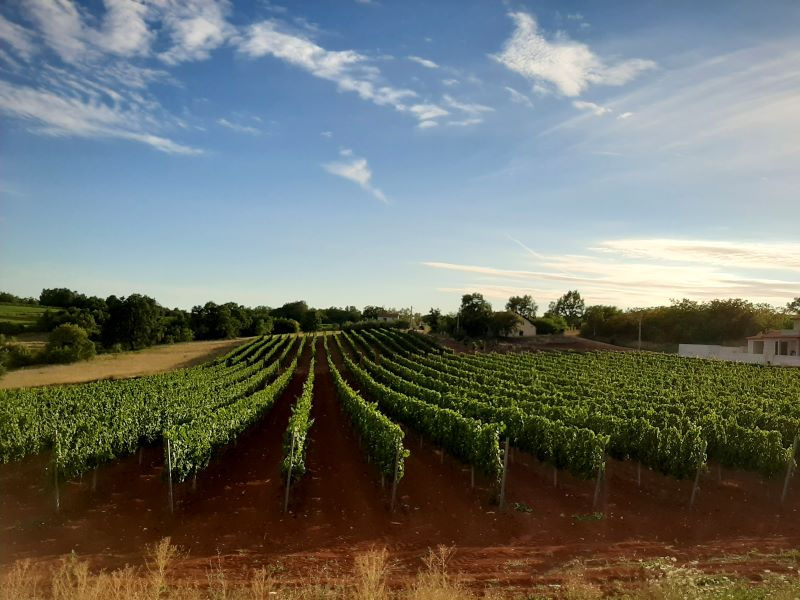
Thus, in 2001 they began bottling, and two years later planted new vineyards of red varieties – one hectare each of Cabernet Sauvignon and Cabernet Franc. At that time, they had around four hectares in total, with the remainder consisting of 1.5 hectares of Malvasia and 0.5 hectares of Chardonnay. Today, the winery owns six hectares in the areas of Verdinac (Malvasia), Doci (red varieties), as well as Businac and Jadro. Last March, an additional hectare each of Teran and Chardonnay was planted, with the first harvest expected in 2028. As Marijana explains, the intention is to gradually expand the assortment in the coming years, while construction of a new cellar with a tasting room is planned for next spring. Currently, the wines are kept in the cellar of an old house, while the barriques are stored in an even older stone house, nearly three centuries old, covering 75 square metres.

It appears that Giulio, together with his professionally trained daughter, is achieving a qualitative leap not only in wine production but also in processing facilities and hospitality for wine lovers. These results will become even more evident in the coming years. The winery has repeatedly won gold medals at Vinistra, including in 2023 and 2024 for its Malvasias (including Erudita), as well as gold medals for Cabernet Sauvignon and Cabernet Franc in 2021. Their wines are sold at the winery itself and in several Istrian restaurants. Average annual production amounts to 35,000–40,000 bottles. 🏅
During the workshop, we had the opportunity to taste the following wines:
Istrian Malvasia 2024 – 14% alcohol
Istrian Malvasia 2023 – 13%
Chardonnay 2022 – 13.5%
Erudita Malvasia 2019 – 14%
Cabernet Franc 2022 – 14%
Cabernet Franc 2021 – 14%
Cabernet Sauvignon 2022 – 13.5%
Cabernet Sauvignon 2018 – 14.3%

The 2022 Chardonnay (13.5% alcohol) is straw-yellow to golden in colour with greenish reflections, offering aromas of peach and tropical fruit. On the palate, one finds creaminess and buttery notes, alongside subtle stone fruit and a hint of yeast. It was aged on the lees for three months, with malolactic fermentation carried out in stainless steel. Slightly bitter on the finish, it is aromatic and rich, though there is a slight imbalance between its excellent nose and body. Nonetheless, it is a wine without major faults and pairs well with dishes such as fish (sardines, tuna), turkey, duck, Istrian sausage, and žgvacet.

The 2019 Erudita Malvasia is exceptional in every respect. It was Marijana’s graduate project focused on the sur lie method, and as many as 146 aromas were identified, compared to around one hundred in a typical Malvasia. Its characteristics impressed all present. The wine is crystal clear, golden yellow with greenish reflections that still indicate freshness even after six and a half years. It is dense and concentrated, with aromas of yellow fruit (quince, pear) and yellow flowers.
After stainless steel ageing, the wine spent three full years in acacia barrels made by a local Istrian producer, followed by a further seven months in stainless steel and additional bottle ageing before release. Despite its 14% alcohol, it is perfectly integrated – nothing protrudes, and the wine is beautifully rounded. As it opened in the glass, hints of mango emerged. It can be enjoyed on its own, but also pairs excellently with asparagus, white truffles, mushroom risotto, seafood risotto, or wok dishes with beef. A truly captivating and pleasurable nectar from Marijana’s workshop! ✨

The 2022 Cabernet Franc (14% alcohol) is also well balanced. It is clear, garnet red in colour, with intense aromas of forest berries (raspberry, blueberry), sweet spices, a slight herbal note, and only a subtle influence of French oak. On the palate, it offers fine tannins, softness, freshness, and elegance. The vines grow in the Doci area, which enjoys full-day sun exposure – ideal for this variety. Planted in 2003, the wine was aged in lightly toasted barrels of 500, 1,000, and 2,000 litres. Lugarić recommends pairing it with boškarin beef, Florentine steak, fatty tuna, or ombolo. A Bordeaux-style wine that is also enjoyable on its own.

The 2022 Cabernet Sauvignon (13.5% alcohol) is a vibrant ruby-garnet wine, dense, with pronounced “legs”, elegant and aromatic with notes of red berries (currant, blueberry). It shows maturity, has a slightly lighter body but pleasing acidity and well-integrated tannins. A refined, easy-drinking, modern wine suitable for all seasons. It was aged for 24 months in barrels, and the grapes are harvested after Cabernet Franc, typically from early to mid-October. Recommended pairings include steak, red meat in general, lasagne with béchamel, žgvacet, Bolognese, and Istrian prosciutto.
With the completion of Marijana’s studies, Giulio Ferenac’s winery has gained an oenologist who knows exactly what she wants and how to achieve it. Together with her father, who has built this wine story over many years, they have elevated the quality of all their wines. The winemaker’s philosophy is not to release wines onto the market until they are truly ready – a principle well captured by the Latin phrase festina lente (“make haste slowly”). There is also support from her husband Bruno Šarić, who was present at the tasting, and from her sister Kristina, who is involved in tourism and partly in marketing.If you find yourself in Istria near Vižinada, do not miss this solid winery striving for excellence!


Comments