


Tracing Brgujski kapuz in Stancija Kovačići

After finishing our visit to Veli Brgud, we descended to Rukavac, a settlement situated slightly above the centre of Matulji. It lies on the slopes of Orljak and Beljč and is connected by local roads with Opatija and Jušići, while the Rijeka railway line passes nearby. Rukavac has a strong tradition of bell-ringers and bell-ringing processions during the carnival season, which begins on St Anthony’s Day (17 January) and lasts until Ash Wednesday. The Rukavac bell-ringers wear sailor-style shirts and white trousers, while on their heads they wear special bell-ringers’ hats called krabujosnice—old hats decorated with colourful crepe-paper flowers, ribbons and asparagus twigs. For this reason, cabbage is also traditionally eaten here during the “fifth season” of the year—the carnival period—and some restaurants, such as Stancija Kovačići, strive to include Brgud cabbage in their menu.

The word stancija once referred to a house on an estate where workers or tenants were accommodated. Stancija Kovačići takes its name from the family nickname, as the owner’s great-grandfather was a blacksmith. The owner of the stancija is Mr Vinko, who showed an interest in hospitality from his school days. After completing hospitality school, he worked in several local restaurants in the area before deciding to start his own business.

Or perhaps it would be more accurate to say that he continued the family tradition, since both his own family and that of his wife were involved in hospitality. Here one can truly feel a deep love and dedication to the craft, confirming the old saying: “If you do what you love and love what you do, nothing is difficult.” The stancija was opened on family land and has been operating in this space for more than seventeen years. Vinko is devoted to the kitchen and personally participates in the preparation of food on a daily basis, ensuring that the ingredients are domestic and sourced from local producers.

Or perhaps it would be more accurate to say that he continued the family tradition, since both his own family and that of his wife were involved in hospitality. Here one can truly feel a deep love and dedication to the craft, confirming the old saying: “If you do what you love and love what you do, nothing is difficult.” The stancija was opened on family land and has been operating in this space for more than seventeen years. Vinko is devoted to the kitchen and personally participates in the preparation of food on a daily basis, ensuring that the ingredients are domestic and sourced from local producers.

The meal began with an aperitif—medica, a honey liqueur from the local honey producer Kos. The small bread rolls served with the meal are made by mixing various types of flour such as wholemeal, maize, buckwheat and spelt, with the addition of blended dried tomatoes and wild leek. The leek is blanched and blended into a cream that gives the rolls a charming greenish colour. These rolls are little masterpieces—rustic, fragrant and perfectly balanced in flavour, with the subtle sweetness of dried tomatoes and the freshness of wild leek giving them their distinctive green note. They were served with a starter consisting of homemade chicken liver pâté and homemade onion marmalade. The pâté is silky, rich and full of flavour, while the onion marmalade provides a beautifully caramelised sweetness that completes the dish. Together with the rolls, the combination creates a harmony of sweet, savoury and earthy flavours that delights from the very first bite.
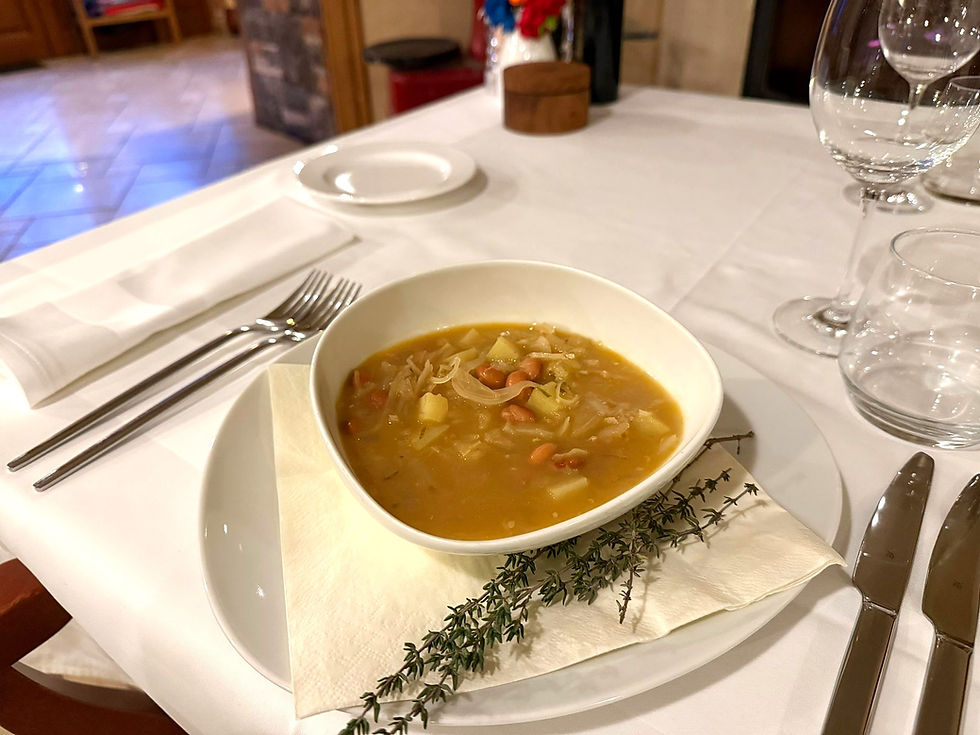
The warm dish was jota, prepared by gently sautéing onions in pork fat, to which bacon, garlic and parsley are added to create a pesto-like mixture. The ingredients are finely chopped or blended to form a spread. The cabbage is cooked separately and drained so that it is not too sour, then mixed with the onions and covered with water, sometimes with the addition of a beef stock cube for flavour. It is cooked for about 45 minutes until softened, after which potatoes are added and cooked for a further 15–20 minutes; beans may also be included.

Seasonings may include thyme or bay leaf, or a chilli pepper for those who prefer a stronger flavour. The preparation method is particularly impressive—each ingredient has space to shine, yet together they create a rich, layered whole. It is a dish that evokes childhood memories, yet with a touch of culinary refinement.

For the main course, beef cheeks were served, cooked sous-vide in vacuum for 48 hours at 72°C. The accompaniments were sauerkraut and potatoes baked with škripavac cheese and served in thin layered slices (millefeuille style), together with a permi-glace sauce made from beef bones slowly cooked in red wine. The meat is most often sourced from the Azra cooperative in Istria, though also from Slavonia. The texture is incredibly tender—almost buttery—while the flavour is deep and concentrated. Each bite literally melts in the mouth, revealing the richness of slow cooking and the natural juices of the meat. The permi-glace sauce, obtained by long cooking of beef bones in red wine, is a true essence of depth—thick, glossy and aromatic—bringing refined strength to the dish. The wine list includes local, high-quality wines and, due to the connection with Istria, Malvasia is frequently featured. The aim is to achieve quality rather than quantity.

For the main course, beef cheeks were served, cooked sous-vide in vacuum for 48 hours at 72°C. The accompaniments were sauerkraut and potatoes baked with škripavac cheese and served in thin layered slices (millefeuille style), together with a permi-glace sauce made from beef bones slowly cooked in red wine. The meat is most often sourced from the Azra cooperative in Istria, though also from Slavonia. The texture is incredibly tender—almost buttery—while the flavour is deep and concentrated. Each bite literally melts in the mouth, revealing the richness of slow cooking and the natural juices of the meat. The permi-glace sauce, obtained by long cooking of beef bones in red wine, is a true essence of depth—thick, glossy and aromatic—bringing refined strength to the dish. The wine list includes local, high-quality wines and, due to the connection with Istria, Malvasia is frequently featured. The aim is to achieve quality rather than quantity.
For dessert, milk rice was served with cinnamon and lemon zest, enriched with butter, sugar and a little prošek, accompanied by a crumble of ginger cake and a few hazelnuts, giving the dish a distinctly winter character in keeping with the season. The rice pudding evokes childhood memories, yet with the addition of prošek, butter and lemon zest it acquires an elegant, almost festive note. The warmth of cinnamon and the citrus freshness create a perfect winter atmosphere. The crumble of ginger cake and hazelnuts brings a pleasant textural contrast and a gentle spiciness that adds depth and character to the dessert. It is a conclusion to the meal that simultaneously warms, comforts and delights—seasonal, sincere and well-rounded.


Comments