


Jing Yuan: Zagreb’s Most Serene Chinese Tea House

In a quiet corner of Gajnice, one of Zagreb’s greenest and most self-contained neighborhoods, there is a place where time seems to move at a different rhythm. Here, in a small tea house Jing Yuan that doubles as a bistro, life is measured not in minutes or messages, but in cups — steaming, fragrant, unhurried cups of Chinese tea.

Walking through its unassuming doorway feels like stepping across a threshold into another state of mind. A few wooden tables, numerous small pieces of Chinese culture and identity, delicate cups, and the faint scent of oolong meet every visitor. The light Chinese traditional music couples with the gentle bubbling of a kettle and the rhythm of hot water poured with care.

The tea master Alex Wang, a soft-spoken man from southern China, moves with the calm precision of someone who has practiced this ritual for decades. His story begins far from Zagreb, in the humid hills of Fujian, where tea has been cultivated for centuries. Yet, his journey led him — almost by chance — to Croatia. “We first came here in 2014,” he recalls. “My wife and I wanted to travel. We didn’t know much about Croatia, but when we arrived, we felt something — a kind of comfort. The people were warm, the pace of life was slower. We thought: maybe this is where we can make a small, peaceful place.”
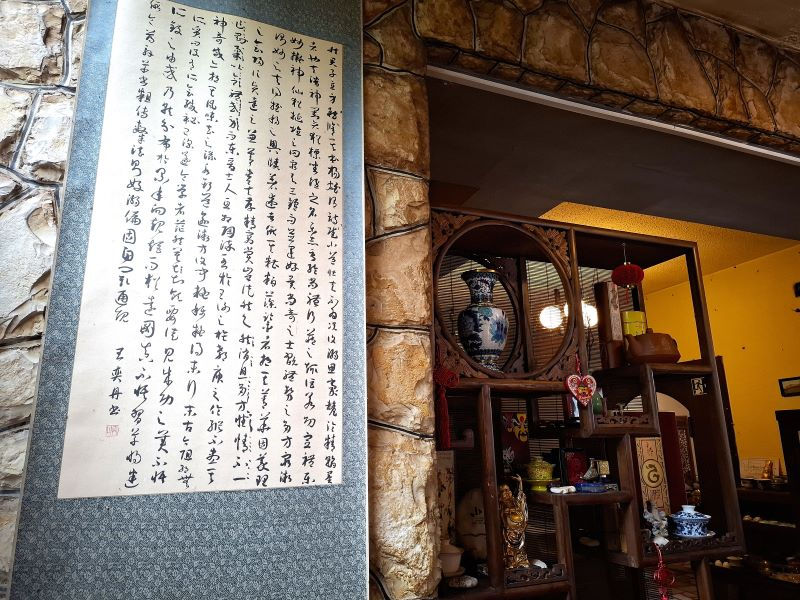
That vision became reality some years later. Their tea house opened quietly, without fanfare, but word began to spread among those who sought authenticity — and calm. Unlike many Asian-themed restaurants that chase exotic spectacle, this one breathes humility. Everything has its purpose: a low table, an earthen teapot, a bamboo scoop. And, of course, the dumplings.

“Dumplings are our tradition,” he says, with a smile that seems to light up the entire room. “Every important family event begins with dumplings. It’s how we come together — birthdays, New Year, even farewells. For me, making them here, in Croatia, is a way to feel at home.” His wife Ivy prepares them fresh every morning. The dough is soft, the folds tight and even, each piece a small act of devotion. Inside, the fillings vary: minced pork and onion, or cabbage, carrot, egg, and rice noodles for a vegetarian option. They are steamed gently, never rushed. When served, they release a subtle cloud of aroma — earthy, warm, comforting.

The bamboo and mushroom noodles are a quiet revelation — a bowl that celebrates the earthy simplicity of forest and field. Glass noodles form the delicate base, light and translucent, catching every nuance of the broth. Tender bamboo shoots add a crisp sweetness, while the rehydrated dried mushrooms release deep, woodsy notes that anchor the dish. Black fungus brings a subtle crunch and a whisper of smokiness, balanced by the gentle tang of pickled vegetables that brighten each bite. Together, these ingredients create a symphony of textures — soft, crisp, silky, and vibrant — evoking the essence of East Asian comfort food: humble, nourishing, and profoundly satisfying.

Locals come back not just for the food, but for the feeling. “Our guests often tell us their body feels easier after tea,” he says, amused. “That’s exactly what we want — for people to feel light, open, relaxed.” That idea — ease — is at the heart of everything here. In the Chinese philosophy of tea, the act of drinking is not merely about taste, but about balance. The tea master explains:
“ When tea is light, the mind becomes wide. You forget yourself. You become part of nature.”

He pours a new infusion of Red Tea into a tiny clay teapot that he calls his “breathing companion.” “This clay is alive,” he says. “It remembers. The teapot absorbs the essence of every leaf. The more you use it, the more beautiful it becomes. It’s like a person who grows wise with time.”
The ritual unfolds in silence. Every gesture is deliberate: rinsing the leaves, warming the cups, letting the tea bloom for just the right number of breaths. Watching him work is like witnessing meditation in motion.

For Croatian guests, many of whom are new to the deeper dimensions of tea culture, the experience is both exotic and surprisingly intimate. “People think tea is something you drink when you’re sick, or when it’s cold,” he says, smiling again. “But tea is for living. It’s for listening, for breathing. In China, we say: tea teaches patience.”

Chinese tea is far more than a beverage — it is a living link to history, philosophy, and nature. Each tea leaf carries centuries of cultivation and care, from the misty mountains of Fujian to the ancient tea forests of Yunnan. Whether it’s the bold depth of Pu-erh, the floral delicacy of oolong, or the light sweetness of white tea, every variety reflects its landscape, soil, and artisan’s touch. Prepared simply, without milk or sugar, Chinese tea reveals purity — an honest dialogue between water and leaf. Its beauty lies in balance: warmth without heaviness, clarity without sharpness. Drinking it is less about stimulation and more about centering oneself — a pause in the day that refreshes both body and spirit.

The ritual of tea in Chinese culture is a graceful choreography of mindfulness. It begins with silence — the careful selection of leaves, the warming of cups, the slow pouring of water. Every gesture honors harmony, respect, and patience. The teapot, often made of red clay, is cherished as a companion that “remembers” every infusion, growing richer over time. Tea is not drunk in haste but savored in small sips, each revealing new layers of aroma and feeling. Sharing tea is a gesture of friendship and humility — a way to listen, connect, and be present. In this simple act, the Chinese tea ceremony becomes both meditation and art, reminding us that peace is found not in grand moments, but in the quiet grace of everyday life.

Over the years, he has come to see unexpected parallels between Chinese and Croatian sensibilities. “Both cultures love family, home, and nature. Here, people like to sit long, talk slowly, eat together. That’s very Chinese too. Maybe that’s why I felt at home so quickly.” He’s particularly fond of the Croatian respect for simplicity. “You don’t hide behind things here. You let food taste like itself. That’s the same in good Chinese cooking — you let ingredients speak. You don’t push them.”

It’s easy to understand why this modest tea house has become a quiet oasis for locals, artists, and travelers who find themselves overwhelmed by the speed of modern life. In a world that celebrates noise and novelty, there is something radical about stillness.
When asked if he misses China, the tea master pauses for a long moment. “Sometimes,” he admits. “But I bring my home with me — in my teapot, in my dumplings, in the way I greet people. I think that’s the secret of belonging: to carry it inside you.”

As the afternoon light fades, he pours one last cup. The liquid is amber, translucent, reflecting the soft glow of the room. “This tea,” he says, “is easy tea. Easy for the body, easy for the heart.” Apart from Red Tea, guests can enjoy many varieties of Green, Yellow, Oolonh, White, and Dark teas. And in that small act — between a cup of tea and a warm dumpling — East and West meet not as opposites, but as reflections of the same longing: the longing for balance, beauty, and peace.

JING YUAN Teahouse & Bistro
Stare Gajnice 13, Zagreb
091 600 9743


This beautifully captures the peaceful atmosphere of Jing Yuan and the calming ritual of enjoying authentic Chinese tea. It’s refreshing to read about a place that encourages people to slow down and appreciate culture, tradition, and meaningful moments. Likewise, a criminal justice course helper supports students by simplifying complex legal concepts, offering academic guidance, and helping them stay organized while developing a deeper understanding of the justice system.